Oversized Sunglasses Sourcing: Three Paths, Picked by Timeline and Lens Spec
-
There's no single right answer — it depends where you sit in the process
-
Before you pick a path: the bottleneck on big frames is the lens blank
-
Path A: your calendar sets the pace (12+ weeks)
-
Path B: the calendar is chasing you (under six weeks)
-
Path C: polarization is a hard spec, not a nice-to-have
-
So which path are you actually on?
There's no single right answer — it depends where you sit in the process
Almost every oversized sunglasses sourcing conversation I've been pulled into starts with the same question, and it's usually the wrong one. People ask "what's the best way to source oversize sunglasses?" But the answer splits hard depending on whether you're sourcing on your own calendar or sourcing backwards from someone else's launch date.
Those two situations point to different suppliers, different price bands, and different risks. So instead of pretending there's one universal recommendation, I'll lay out the three paths I actually use:
- Path A — You own the calendar. Time for tooling, sampling, and a second attempt.
- Path B — The calendar owns you. A retail set date or promo event is locked in, and you have weeks, not months.
- Path C — Polarization is a hard spec, and you need documentation, not a verbal promise.
None of these paths is "best." They're each the correct answer to a different set of constraints.
Before you pick a path: the bottleneck on big frames is the lens blank
This is where new buyers get burned. And it burns quietly.
Standard lens blanks run 65–70mm in diameter. Polarized blanks are commonly the same. But a genuinely oversized frame — 55–60mm lens width with an extended temporal side — cuts out larger than you'd expect. If your supplier only stocks 65mm blanks, you get thin, decentered lenses with an optical center nowhere near the pupil. They'll usually tell you it's fine.
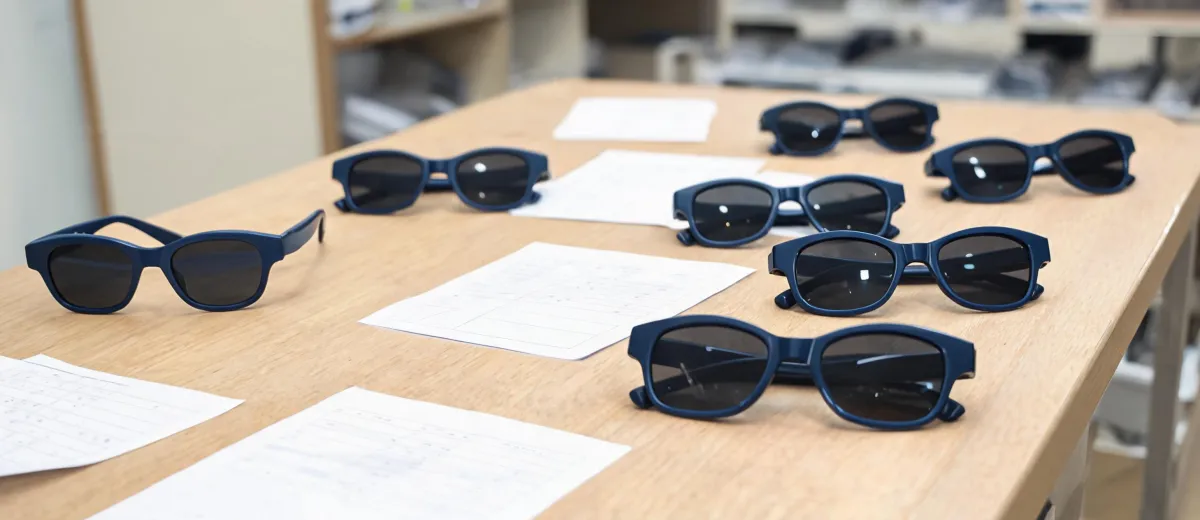
When I put our Q1 and Q3 shipments side by side on the same table — same frame, same factory, only the blank supplier changed — I finally understood why oversized frame programs drift so badly. The Q1 batch had optical centers sitting two to three millimeters out from the pupil. Several wear testers reported headaches. The Q3 batch used 75mm blanks, same frame, same factory, zero complaints. Same frame. Different material.
So ask this before you ask about price: "What blank diameter do you cut your oversized frames from, and do you carry 72mm+ stock consistently?" A vague answer is your answer.
One more thing worth walking through: in the US, sunglasses are regulated as medical devices under 21 CFR 886.5850, and ANSI Z80.3 is the reference standard most factories and buyers cite for lens performance. If a supplier can't produce test documentation against either, you're not buying protection — you're buying tinted plastic.
Path A: your calendar sets the pace (12+ weeks)
If you've got twelve weeks or more, I'd argue against chasing cost. Buy back the option to be wrong instead — you can still afford it.
- Sample. Then sample again. Test on real faces. This matters most for oversized sunglasses for women — a 55mm lens width that reads as a design choice on one face becomes a caricature on another. If your target market spans regions, sample per region, not once.
- Quote the frame and the lens separately. Frame, lens cutting, and coating as separate line items. A bundled number won't tell you whether the blank is actually big enough, or whether the polarizing film is real or a sales line.
- Ask for optical test documentation directly. You want transmission, UV400, and prismatic deviation figures. Not every factory is used to being asked — fine. Use the request as a filter.
Path A is the only path where you get an actual cost-versus-quality tradeoff. Once the timeline compresses, there's no tradeoff left — only accept or walk.
Path B: the calendar is chasing you (under six weeks)
This is my home turf. Rush orders are what I actually handle, and there's a lesson I wish every buyer internalized early: going direct to the factory is often the most expensive option when the timeline is tight.
Here's the counterintuitive part. Everyone assumes cutting out the middleman saves money. For stock, in-stock-color oversized frames, the opposite is usually true. A factory with its own molds and its own production schedule is slow to slot you in. A trader sitting on ready inventory — or a factory whose molds have already been run for the market — can ship tomorrow. You're paying a time premium, and you're buying back control of your own calendar.
When I'm triaging a rush, I work it like this:
- Take the in-stock frame. Skip the custom color. A ready-color oversized frame and a "custom Pantone oversized frame" are two different lead-time promises.
- Pressure-test any claim of "75mm polarized blanks in 10 days." Those blanks are low-volume by nature. If the answer is yes, ask who makes the blank and get the name of the factory.
- Settle the lens spec before you settle the look. You can delay a colorway. You can't delay where the optical center lands.
Honestly, I've never fully understood why quoted prices on the same polarized oversized specification range from about four dollars to fourteen. My best guess is it comes down to blank origin, whether the coating is done in-house or sent out, and how much contingency the vendor bakes into rush pricing. I've never gotten a clean explanation, and it doesn't fully add up on paper.
Path C: polarization is a hard spec, not a nice-to-have
If polarized oversized sunglasses are your non-negotiable, your supplier filter isn't the same filter you'd use for general sourcing. Price moves to second position. Verifiability takes first.
Here's why it matters. Polarization isn't a coating applied over a lens — it's a film embedded in the blank, and it has an alignment orientation. Larger lens area means more room for that film to be off, and more scrap at the factory. That's why polarized oversized frames cost more than the same frame non-polarized. It isn't a marketing premium; it's a yield difference.
For this path, I'll only work with a supplier that:
- States the polarizing film origin and its alignment tolerance in writing;
- Provides filmed documentation of a block test or equivalent — not "we guarantee, don't worry" (no thanks);
- Backs UV400 with a numeric figure. UV400 generally means absorption up to 400 nanometers, but "UV400" printed on a box isn't data — a test report is.
Quick note on timing: I locked in these criteria in early 2025. Standards and regulations move, so verify the current ANSI revision and the specific test methods before you sign a supplier agreement.
So which path are you actually on?
Forget the supplier decks for a minute. Ask yourself three questions, in this order:
- What's the latest date you can accept delivery? If the answer is "twelve weeks, and I'm flexible," that's Path A. If the date is already bought and paid for, that's Path B.
- Is polarization a hard spec or a preference? If it's hard, you're on Path C — regardless of how tight the timeline is. The number of suppliers who can serve you honestly is small. Don't filter them with generalist criteria.
- What's your target lens width? If it's over 55mm, ask the blank question before anything else. That one question will eliminate half your list.
Run those three honestly and you'll know your answer before you open the first inquiry email. That's the whole point of explaining the tradeoffs up front — I'd rather spend ten minutes walking someone through their options than have a mismatch surface later, when nobody can fix it.