When a Client Needed 800 Pairs of Oversized Sunglasses in 11 Days: A Sourcing Story
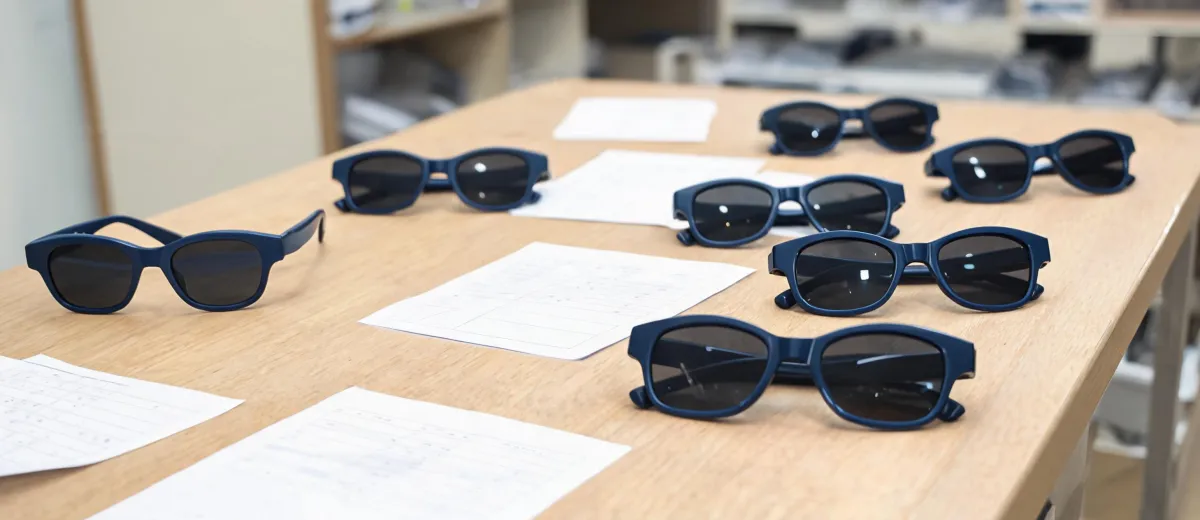
The call came in on a Thursday afternoon in March 2024. A buyer for a resort-wear brand needed 800 pairs of oversized sunglasses for a pop-up event in Miami — 11 days out. Normal production lead time for polarized oversized sunglasses from most of our factories: 30 to 45 days. She knew that. She'd already been turned down by two other suppliers.
I remember checking my watch. 3:47 PM. Then I did the math: 11 days meant the frames needed to ship by the following weekend, which meant the lenses had to be cut, tinted, and polarized within roughly 72 hours of the frames arriving from the molding line. Tight, but not impossible. I'd handled faster.
That's the thing about rush sourcing. It's rarely about one bottleneck. It's about a chain of them, and you only need one weak link to blow the whole thing.
Why Oversized Frames Break the Normal Playbook
Here's what most buyers don't realize until they're in the middle of it: oversized sunglasses are not just regular sunglasses scaled up. The geometry changes everything.
Larger frames (think 60mm and up in lens width) put more stress on the lens material during the polarizing process. The film has to stretch further. On cheap acetate templates or low-end polycarbonate blanks, that stretch introduces optical distortion — you get that weird rainbow effect at the edges, or worse, the polarization axis drifts a few degrees off-spec. For a customer buying a $30 pair of oversize sunglasses at a resort gift shop, they may not notice. For a buyer accountable to a brand's quality team, it's a return waiting to happen.
So when I'm triaging an emergency order for oversized sunglasses women's styles — especially polarized — the first question isn't "which factory is fastest." It's "which factory has actually done this at this scale, at this lens size, with this deadline?"
The First Inkling Something Was Wrong
I found a factory in Shenzhen I'd used twice before. Good quality on standard sizes, decent turnaround, honest communication. I asked the sales manager — let's call him Wei — a direct question: "Can you handle 800 pairs of oversized polarized sunglasses, 62mm lens width, delivered to Miami in 11 days?"
He said yes.
I asked if the polarizing line was running at capacity. He said it was fine. I asked about the lens supplier's stock on 62mm polarized blanks. He said no problem.
Looking back, I should have asked for the lens supplier's name and called them myself. But we'd worked together before, and I thought "what are the odds the one time it matters is this time?"
The odds caught up with me on Day 4.
The Problem No One Flagged
Wei called at 8 PM my time. The frame molding was on schedule. The problem was the polarizing film. His usual lens supplier didn't stock enough 62mm polarized film in the specific gradient tint the client wanted — brown-to-amber fade — and the alternative supplier could ship in five days, not two.
Five days put us at Day 9. That left two days for assembly, QC, packaging, and air freight to Miami. Not workable.
Here's the lesson I keep re-learning: in rush sourcing, the answer to "can you do it" is never just about the factory's willingness. It's about their upstream suppliers' inventory, and whether the sales rep you're talking to actually has visibility into that inventory or is just telling you what you want to hear.
"The value of guaranteed turnaround isn't the speed — it's the certainty. In emergency sourcing, a 'maybe' is worse than a 'no.'"
The Pivot (and What It Cost)
I had two options. Option one: switch the client to a solid brown polarized lens — in stock, ready to cut, no delay. Option two: find another factory with the gradient film and risk a messier handoff.
I called the client. She was calm, which honestly made it worse. I explained the situation in about 90 seconds. She asked one question: "Will the solid brown look cheap?" I told her the truth — it wouldn't look cheap, but it would look different from her original spec, and her event collateral already showed the gradient.
She paused. Then: "Can you get the gradient from someone else?"
I could. And I did — a smaller factory in Dongguan I'd used for a women's oversize sunglasses line the year before. They had 600 pairs' worth of film in stock. I needed 800. They called their film supplier, who had the rest in a warehouse 40 minutes away. If we placed the PO by 10 AM the next morning, they could start cutting by noon.
Cost impact: $1,400 extra in expedited film procurement, plus $600 in split-freight logistics because the lenses and frames were now coming from two facilities. On a base order of roughly $9,200, that's a 22% overrun.
We paid it. The client approved it. The alternative — missing the event — wasn't just about the $9,200. Her team had already booked the venue, the photographer, the influencer walkthrough. Missing the sunglasses meant missing the story.
What Actually Shipped
Day 10, 11:40 PM. 803 pairs (the factory ran a few extras, which I'll take). Brown-to-amber gradient, 62mm lens width, acetate oversized frame, polarized. We did a 10% AQL inspection on the lens axis and edge distortion. Two pairs failed. The factory replaced them from the overrun.
They landed in Miami the morning of Day 11. The pop-up opened on time.
Would I call that a win? Sort of. It was a win for the client. For us, it was a $2,000 lesson in asking better questions on Day 1.
What I'd Do Differently (and What I Now Require)
If I could redo that decision, I'd have asked Wei for his lens supplier's contact before I confirmed the order. Not to go around him — because if a sales manager can't or won't give you visibility into the upstream chain during a rush, that's information. It tells you where the risk lives.
We now run a three-step check on any oversized sunglasses sourcing request with a turnaround under 21 days:
- Confirm lens stock independently. Not "we have it" — a stock count, a location, and a hold placed in our name.
- Split the timeline. Frames and lenses get separate production dates, separate QC checkpoints. If one slips, we know within hours, not days.
- Build a 15% contingency into the quote. Rush sourcing without a cost buffer is just optimism with a purchase order.
And the minimum order quantity question — that's the other part of this story. This client's order was 800 pairs. We've run rush orders as small as 120 pairs for oversize sunglasses for women's boutiques opening a single weekend. The factories that laughed at 120 pairs are the same ones who called us six months later asking for volume introductions. Small doesn't mean unimportant. It means early.
So here's the honest version: emergency sourcing for polarized oversized sunglasses isn't about finding the fastest factory. It's about finding the factory that tells you the truth about the second-fastest one. And that's a relationship you build one rush order at a time.