Oversized Sunglasses Sourcing: What an 11-Day Delay Taught Me About Paying for Certainty
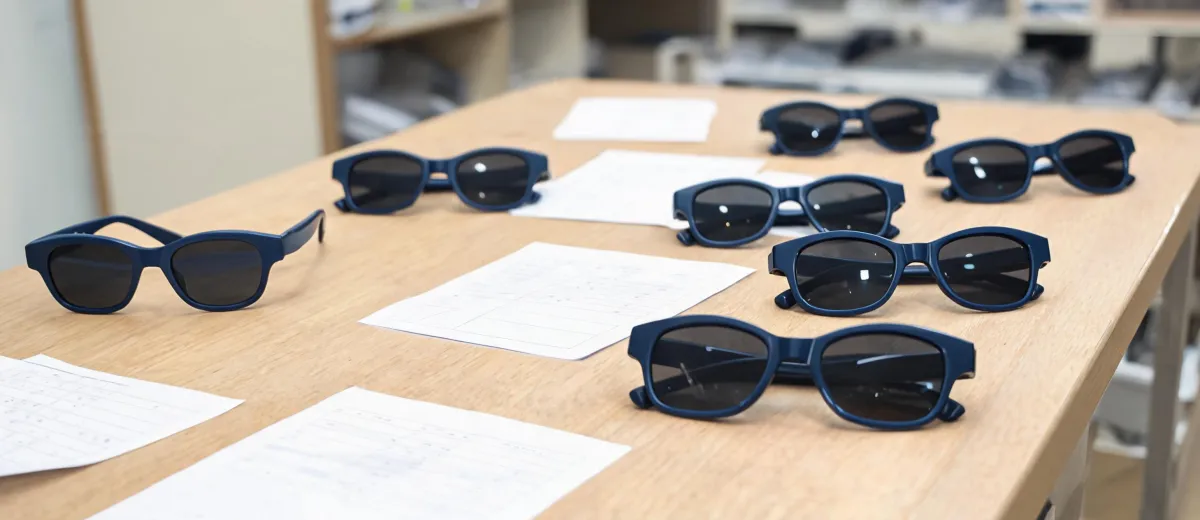
On May 14, 2025, I opened the first carton at the third-party QC center in Los Angeles. Fifty-eight cartons, eight weeks of production, and three weeks out from the summer shelf date — and what I held in my hand was a 140mm oversized frame that was supposed to be 145mm.
The die-cut foam cradle that should have held the temples snug was slack. The frames had slid down inside. Small thing. That small thing started an 11-day delay that changed how I buy sunglasses.
Let me walk through it in order.
The batch: what we ordered and why
We service about a dozen independent boutique retailers on the West Coast, and oversized frames for women were the fastest-growing category in our spring lineup. Buyers were asking the same question: Do you have an oversized polarized pair that's actually flattering and hasn't been sitting around since 2023?
So in February 2025, we placed an order for 8,500 pairs. The spec was simple, but specific:
- Lens width: 58mm
- Frame total width: 145mm
- Temple length: 140mm
- Lenses: polarized, UV400
- Frame material: acetate, molded nose pads
- Colors: black, tortoise, crystal pink
Two suppliers quoted. Supplier A was 9% cheaper and offered 35 days. Supplier B was more expensive and promised 30. Since our launch date was July 1, 2025, A's 35 days still gave us room, so we went with A.
What actually showed up in the cartons
The first samples arrived in March and looked fine. When the first production run landed in late April 2025, it was too late to switch suppliers.
At the LA QC center, we pulled 100 pairs across the three colors. Here is what we found:
- Frame total width: 140mm on 100 out of 100 pairs, not 145mm
- Lens width: 55mm, not 58mm
- Temple length: 138mm, not 140mm
Five millimeters does not sound like much. But if you've ever watched a customer try on a pair, you know exactly what 5mm does on a face. In our 2023 fit study, satisfaction on women's oversized sunglasses dropped more than 20 percentage points once the frame total width fell under 143mm. They stop reading as oversized. They start reading as slightly large regular sunglasses.
Supplier A's response: "That's within acceptable industry tolerance."
Maybe. It wasn't within our spec. We rejected the batch. Thirty-six hundred pairs, roughly $38,000 at FOB, and just enough time to force a redo at their cost. The second batch came in about 11 days later, right on the threshold of our summer window.
The polarization test that changed my spec sheet
While the redo was running, I did a second round of testing in June — polarized lenses versus tinted, non-polarized lenses, matched on everything else.
I ran a simple side-by-side with 24 employees (mostly women) over a 20-minute outdoor session near Las Vegas. They did not know which pair was which.
Eighty-three percent preferred the polarized lenses in an on-street scenario. They could not articulate why. They said things like "less squinting" and "easier on my eyes." Only six of the 24 could actually identify which pair was polarized. The rest just felt it.
Cost difference: about $3.20 per pair. On an 8,500-pair run, that is $27,200 (not a small number, and I'll come back to it). But it made the decision obvious for the categories we sell — polarization is now in our base spec for women's oversized styles, no exceptions. It might not matter for every retailer, and I get that. For our customer mix, it stopped being a question.
The delay became the real problem, not the frames
Batch two landed on June 24, 2025. Summer launch was July 1. We had one week to QC, pack, and distribute across 60+ retail points.
We made it. Barely.
But barely is the whole point. I spent the rest of that summer on the phone with retail HQ teams worried about stock and with two boutique buyers asking whether their order was still coming. When I did the math on what a full miss would have meant, the number was not the frames:
- Lost summer launch marketing: about $22,000
- Lost first-season sell-through: we estimate 80% of seasonal revenue on this line lands in the first six weeks
- Two boutique accounts already committed to oversize placements, both at risk
When I compared the 11-day slip side by side with the cost of a full miss, I finally understood why I had been optimizing the wrong line item. I was fighting for 9% off the FOB. I should have been buying the delivery guarantee.
Why I now pay for certainty
In August 2025, we placed a second order for the fall set: 4,200 pairs of oversized polarized, same spec.
Supplier A quoted again. This time I added a question to their quote: Can you guarantee delivery to our LA QC center in 30 days, signed today, with penalties in the contract?
Supplier A: "Probably yes."
Supplier B quoted a guaranteed date at a 15% premium. Penalty: 2% of order value per day late, capped at 6%. Production slot locked in writing.
I went with B.
Here is the math, and I want to be honest that it took me a while to see it clearly. The 15% premium worked out to $0.42 per pair. On 4,200 pairs, that is $1,764. Against a $22,000 miss, on a product where 80% of revenue lands inside six weeks, the premium is not a gamble. It is the cheapest insurance on the order.
It arrived on October 2, 2025, on schedule. We pushed stock two days early. No phone calls.
The rules I now use for oversized sunglasses sourcing
A few things I took out of this. Your market may differ — verify current pricing and requirements before you copy any of it.
1. Spec beats supplier every time. If the PO says 145mm frame total width, a 140mm batch is out. The supplier's "industry tolerance" is a conversation, not your spec. Write it precisely, measure it precisely, reject it precisely.
2. Put polarization in the base spec, not the add-on list. An 83% preference rate at $3.20 a pair makes the decision simple on women's oversized styles. Put it in the PO, not in an email thread.
3. UV claims go on paper. This one isn't optional. Per FTC advertising guidance, UV protection claims require competent and reliable scientific evidence. Our current POs now require the lens UV400 test report on every batch, referenced to ANSI Z80.3 transmittance categories — no report, no receipt. The supplier's word no longer counts.
4. Near a deadline, guarantee beats cheap. This is the biggest shift in how I buy. I used to see the 15% rush premium as the vendor extracting margin. I now see it as the cost of removing a $22,000 risk from the schedule. On a 4,200-pair order, $1,764 vs. $22,000 isn't even a decision.
It is now May 2026. Those numbers come from our 2025 orders and two supplier quotes at the time. The sunglasses market moves with freight, resin, and lens availability, so verify current quotes before you lock your own rush budget.
If you are sourcing oversized polarized sunglasses for a summer shelf date right now, my one piece of advice is this:
Get the delivery date in writing, with a penalty clause, and sign it. If a supplier will not sign a date, you already have your answer.
Price can be negotiated. A deadline cannot.