An Urgent Oversized Sunglasses Sourcing Story: Why We Paid More for Certainty
The carton that arrived on a Tuesday
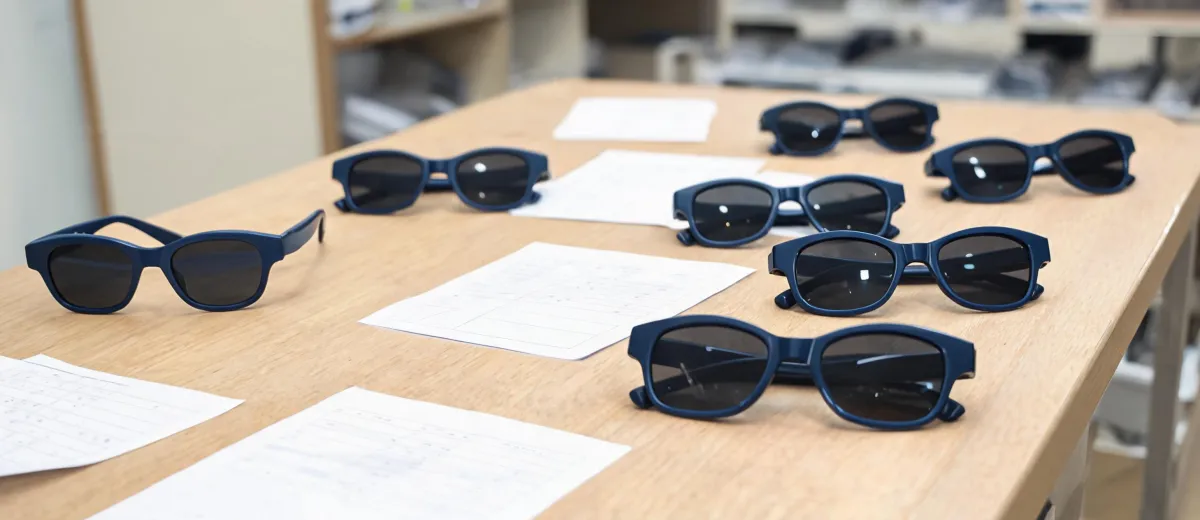
On a Tuesday morning in February 2026, I stood in our inspection room with 12 pairs of oversized sunglasses women's samples spread across a white table. The launch was eight weeks out. Our customer, a mid-size retail brand, needed 8,000 units of polarized oversized sunglasses by April 15. Not 'around April 15.' By April 15, because the campaign was already booked.
I'm the quality and brand compliance manager at an eyewear sourcing company. I review every pre-production sample and bulk inspection report before it reaches our B2B customers—roughly 200 SKUs a year. In 2025, we rejected 18% of first deliveries for some combination of dimension, lens, or finish issues. That number is not a brag. It's why I no longer treat 'on time' and 'to spec' as the same promise.
This story is about oversized sunglasses sourcing under deadline pressure. It's also about a lesson I keep relearning: in urgent work, you don't just pay for speed. You pay for certainty. But you have to define what needs to be certain.
Why we paid the rush premium
The brief was specific. Oversized sunglasses, polarized lenses, women's fit, three colorways, 148 mm frame front width, 145 mm temple length, and a lens that met our UV400 transmittance requirement with test reports. Not 'UV protection' as a vibe. UV400 as a measurable claim.
Our usual factory quoted 45 days, then came back with 60. It happens. Capacity moves. But 60 days meant the goods would arrive after the campaign in-store date. We asked for a guaranteed date. The reply was basically, 'We will try our best.' That is not a date. It's a hope with a tracking number.
We went to a second supplier with a reputation for faster turns on oversize sunglasses. Their quote was 12% higher and included a rush fee. I remember the number because it made me wince: about $4,300 extra on an order that was already not cheap. But the alternative was missing a launch our customer had already promoted. We paid for a 30-day production window plus a written delivery commitment. The quote was 30 days—or rather, 30 days from deposit, not from sample approval. That detail mattered later.
To be fair, I get why buyers push back on rush fees. Budgets are real. But an uncertain cheap delivery is often more expensive than a certain expensive one. If the launch slipped, our customer would be sitting on marketing spend with no product. That loss was not $4,300. It was the campaign.
The samples looked fine. That was the trap.
The pre-production samples arrived in early March. Honestly, they looked pretty good. The oversized shape had the right proportion, the polarized lens passed our quick bench test, and the hinges felt solid. We approved the sample with a few notes: keep frame front at 148 mm ±0.8 mm, keep temple length at 145 mm ±2 mm, and verify polarized axis alignment on every lot.
Then the first bulk carton arrived. I measured 20 pieces out of 500. If I remember correctly, the first three were fine. The fourth was not. The frame front measured 150.2 mm. Still oversized, sure, but it was outside our tolerance and outside the sample we had approved. We kept measuring. Temple lengths were short on six pieces. On three pairs, the polarized axis was off by roughly 5 degrees against our reference lens. You could see it under the polariscope, and a wearer would feel it as uneven glare reduction when tilting their head.
The vendor's response was the sentence I've heard in almost every quality dispute:
This is within industry standard.
Maybe it was. But industry standard is not the same as our approved specification. Oversized sunglasses are not just standard frames scaled up. The lens blank diameter, base curve, decentration, and frame geometry all interact. If a supplier changes the lens blank or the way the front is mounted, the fit and optical behavior can shift. For an oversized sunglasses polarized lens program, a few degrees of axis error is not a cosmetic issue. It affects how the lens performs in real glare.
The turn: certainty had a second meaning
We had a choice. Accept the batch with a discount and hope the customer's QA team did not measure. Rework the frames and miss the ship date. Or split the order: rework what we could, air-freight a partial shipment, and pull from a backup stock program for the rest.
This is where the rush premium got complicated. We had paid for delivery certainty, but not for specification certainty. The supplier's 'guaranteed' date was based on factory ship date, not warehouse receipt. I should add that detail to every PO now: guaranteed delivery means delivered to our consolidator, customs cleared, not 'handed to freight forwarder.' Those are different promises.
We rejected the first bulk batch. The vendor reworked the frame fronts and replaced the out-of-tolerance lenses at their cost, but we still lost time. We paid about $6,800 for air freight on the first 3,200 units. The original ocean plan would have been cheaper, but cheaper was no longer the point. The customer needed product in stores. We also pulled 1,500 units from a backup supplier that had passed our previous audit, which cost another premium.
In the end, the launch made it. The first units landed six days before the in-store date. We did not miss the campaign. But I would be lying if I said it felt like a clean win. It felt like a save. The $4,300 rush fee was only one part of the cost. The real cost was the inspection time, the air freight, and the fact that I had to tell our customer that 'guaranteed' had a fine-print definition.
What I changed after that run
We didn't have a formal pre-shipment checklist for oversized frames until that batch. Cost us when a supplier measured the frame front at the widest point while we measured at the hinge line. Same frame, different number, endless argument. Now every contract includes a measurement diagram, the exact points, the tolerance, and the inspection stage. I finally created a one-page verification protocol after this incident. Should have done it two years earlier.
For oversized sunglasses sourcing, my checklist now has four gates:
- Spec gate: Frame front width, temple length, bridge width, lens thickness, and weight range. In the oversized sunglasses women segment, fit checks matter as much as frame width. We also check nose bridge clearance and temple grip. Oversize frames fail by slipping, not just by looking wrong.
- Lens gate: Polarized axis alignment, UV400 transmittance report, and a visual distortion check. We ask for the test standard and the lab report, not a certificate logo on a box.
- Delivery gate: Guaranteed date defined as warehouse receipt. Penalty clause tied to that definition. Rush fee paid only when the date is written into the PO.
- Inspection gate: AQL sampling before shipment plus a 20-piece measurement check on every lot. For polarized oversized sunglasses, we add the polariscope check on the same sample.
I also started requiring a signed sample photo set with calipers in frame. It feels excessive until the first dispute. Then it feels cheap.
Why I still pay for certainty
In my opinion, the rush premium was worth it—but not for the reason I first thought. It wasn't worth it because faster is better. It was worth it because the deadline was real, and a reliable date let us plan the rest of the chain. The mistake was assuming 'reliable date' covered 'reliable specs.' It didn't. The premium bought us a shot at the window, not a pass on inspection.
If you're sourcing oversized sunglasses for a dated launch, my advice is to separate the two. Pay for time certainty when the cost of missing the date is clearly higher than the premium. Then pay attention to spec certainty, because that is where urgent orders usually break. A supplier who can hit a date but cannot hold a 0.8 mm tolerance is not actually de-risking your launch.
That said, this worked for us because we're a mid-size B2B company with predictable order patterns and an existing backup supplier. If you're a small brand placing a first-time order, or if you're in a seasonal spike with no audit history, the calculus might be different. I can only speak to the context I know.
Also, this pricing was accurate as of Q1 2026. Lead times and air freight rates move fast in eyewear sourcing, so verify current quotes before you budget. And if you're checking UV or impact claims, don't rely on a supplier's brochure. According to ANSI Z80.3-2018, nonprescription sunglasses have specific transmittance and optical requirements. EN ISO 12312-1 is the comparable European standard for general-use sunglasses. In the U.S., 21 CFR 801.410 addresses impact-resistant lenses for eyeglasses and sunglasses. Ask for test reports against the standard that applies to your market, and verify the report matches the actual model.
The lesson I keep on my desk
The launch survived. The customer never knew how close we came. That is the job, I guess. But I kept one of the rejected frame fronts on my desk for a while. It had a 150.2 mm width and a note in red: 'outside approved sample.' Every time I looked at it, I remembered that urgency does not remove the need for proof. It raises the price of skipping it.
If you've ever chased a container across a holiday week, you know that sinking feeling. Pay for certainty, yes. But define certainty in millimeters, degrees, and delivery terms. Otherwise, you're just paying extra for a nicer version of 'we'll try our best.'