Why Oversized Sunglasses Sourcing Goes Wrong (And a $3,200 Lesson in Specificity)
-
The Mistake Everyone Makes in the First Ten Minutes
-
The Definition Problem Nobody Quotes For
-
The Second Problem: Polarized Lenses Don't Love Curvature
-
The Third Problem: Weight, Balance, and the Two-Minute Sample Test
-
The Compliance Layer Most Buyers Get Wrong
-
The Cost Story: $3,200 for a Test I Skipped
-
What I'd Do Differently (And Now Do)
-
The Small-Client Angle That Changes the Math
-
The Checklist, In Order
The Mistake Everyone Makes in the First Ten Minutes
Most procurement conversations about oversized sunglasses start in the wrong place. A buyer needs 500 pieces of oversized sunglasses for women, polarized, and gets quotes from four to six suppliers. They compare unit price, pick the middle one or the cheapest reliable-looking one, place the order. Then the samples arrive.
The vendor said they'd ship "oversized." Did it look oversized? Sort of. On a flat lay, sure. On a size-six mannequin head, yes. On an actual woman's face at a market fitting in February 2023, no. It looked like a slightly large pair of standard sunglasses. The client held the shipment for three days and then asked for a reorder at a different size. There was no different size. That frame existed in one dimension.
Here's what I learned the expensive way: "oversized" is not a specification. It's a mood. And moods don't travel well across a sourcing chain.
The Definition Problem Nobody Quotes For
"Oversized" means different things to the three parties in any order. To a factory tooling acetate frames, it might mean a 58mm lens width — noticeably larger than their 52mm standard, but still inside their existing mold range. To a women's fashion buyer in Los Angeles, oversized means the lens covers half the cheek, roughly a 62–65mm lens width with a 20mm bridge, on a face of about 140mm temple-to-temple width.
The question everyone asks their supplier is "do you have oversized sunglasses?" The question they should ask is: "What lens width, bridge width, and total frame width in millimeters does your 'oversized' refer to, and can you show it on a 140mm face?"
That second question sounds pedantic until you realize that the first question gets answered with "yes" by about 90% of suppliers, and the second one filters out half of them.
Most buyers focus on per-unit pricing and completely miss setup, re-tooling, and rework costs that come from a size mismatch nobody caught at quote stage. I've watched a 40-cent-per-unit difference eat a 22% cost overrun on a reorder because the original "oversized" got tooled at 56mm and nobody wanted to pay for a new mold.
The Second Problem: Polarized Lenses Don't Love Curvature
Here's where oversized, women's, and polarized converge into a real production issue.
A polarized lens carries a film layer with a consistent orientation across its surface. On a small, flat lens, that's straightforward. On a 62mm+ oversized lens with a wrap or base curve — and oversized styles almost always want a curve because flat oversized looks like a visor — the film can warp during lens curving. A warped film means the wearer gets a shallow gray smudge in one quadrant when they tilt the lens against a screen. On a 4-hour beach test, that shows up as uneven glare reduction.
Test it yourself: hold the lens in front of a computer screen and rotate it 45 degrees. You should see uniform darkening. If one region stays lighter, the polarization is inconsistent. That's a defect. Most buyers test the sample they were mailed for about 45 seconds and call it done. I've been that buyer.
The follow-up question to ask is whether the factory tests polarization efficiency on the actual base curve you're ordering — 99% efficiency is a realistic top band for premium polarized lenses, 95% is acceptable for mid-tier, and anything below that on an oversized curve is worth questioning.
The Third Problem: Weight, Balance, and the Two-Minute Sample Test
Oversized frames are physically heavier. A women's oversized frame with polarized CR-39 lenses lands around 32–38 grams. That's not heavy in absolute terms. But it's front-heavy. The mass sits on the nose pads and the temple contact points.
For a 38-gram frame with 25 of those grams in the front, the nose pads carry most of it. On a two-minute sample test in your office, you won't feel it. On a four-hour real-world wear test — beach, drive, lunch — you'll feel it as temple pressure or a red nose mark. The user returns the product. The client doesn't reorder. The sourcing record shows a bad product, but the actual root cause was a buyer who tested the sample on themselves for two minutes and called it validation.
Here's what I do now: the sample goes home with one person in the target demographic for a full weekend. If I'm sourcing oversized sunglasses for women, a man in our office does not get to approve the fit.
The Compliance Layer Most Buyers Get Wrong
Sunglasses are a regulated product in every major market. In the US, non-prescription sunglasses are Class I medical devices under 21 CFR 886.5850. ANSI Z80.3 is the voluntary standard for non-prescription sunglasses requirements. In the EU, EN ISO 12312-1 applies. UV400 refers to blocking wavelengths up to 400nm — that's a test result, not a marketing claim, and it should come with test data.
For oversized lenses, the UV protection distribution matters too. Gradient tints, mirrored coatings, and heavy curvature can push UV-blocking results unevenly across the lens surface. "UV400" on the center of the lens isn't the same as "UV400" across the entire lens. Request the transmission test data for whatever gradient or tint you're specifying. If the supplier can't send it, that tells you something.
I'm not a compliance attorney, and I'll flag that this is a sourcing observation, not legal advice. Take it with a grain of salt — but take the test data too.
The Cost Story: $3,200 for a Test I Skipped
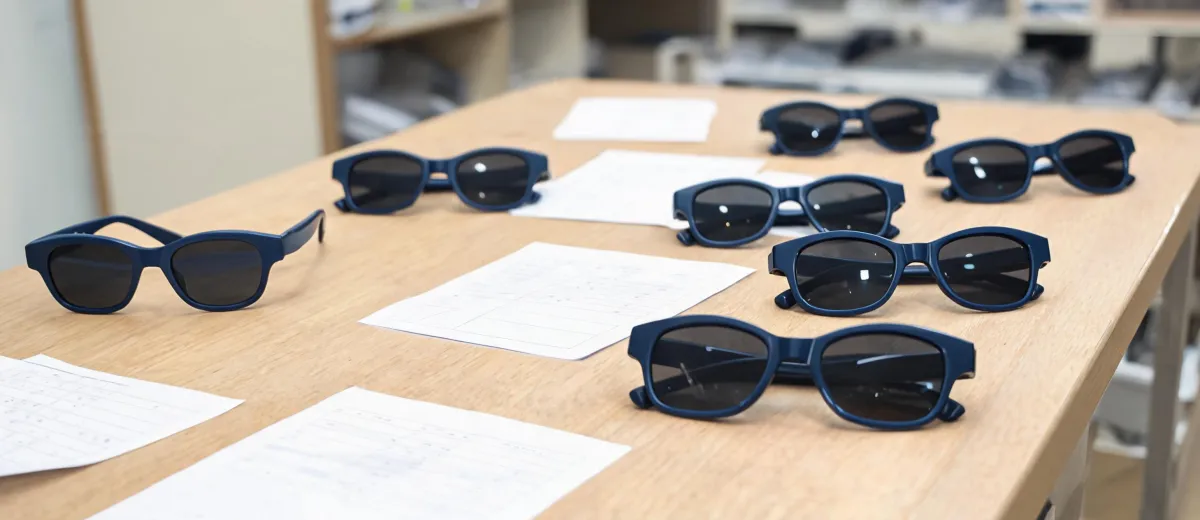
In September 2022, I approved a 600-piece order of women's oversized polarized sunglasses. The frame was a 60mm lens width, on-trend, with a good 6-base curve. Samples looked great in the office and good on our sample wearer for about 90 minutes at a tradeshow.
Production shipped. On arrival, about 140 out of 600 pieces showed visible polarization warp on one edge — a gray smudge under rotation against a screen. The client held the shipment while we sorted. We ended up eating about $2,180 in sorting and re-lamination costs on usable frames, plus roughly $1,020 in a timeline penalty tied to the client's promo event. Total about $3,200. Not the biggest loss I've ever been part of, but easily the most avoidable.
The check I didn't run: I tested three pieces out of the sample order and then trusted the production line. Three out of six hundred. That's the whole story.
What I'd Do Differently (And Now Do)
Two things map to a specific pattern I now follow, and I'll be blunt about why: the first one costs about 40 minutes of work, and the second costs about one weekend of a team member's time.
First, spec the size in numbers before you spec it in adjectives. Ask for lens width, bridge width, and total frame width in millimeters. Ask for a fit shot on an actual person in your target demographic. "Oversized" alone should be treated as a rejected answer, not a helpful one.
Second, run a real wear test and a real polarization count. Twenty pieces from production — not three — rotated against a screen before the shipment is approved. And a full four-hour wear test on a person who represents the target user, not the buyer.
The Small-Client Angle That Changes the Math
If you're a smaller buyer, this whole process sounds expensive. It isn't — not if you frame it right.
The bigger factories I talked to quoted 500 pieces per color per style as the minimum. That's a $3,500+ commitment per SKU before you've validated a single fit or tested a single lens. The suppliers who let me run a 100-piece trial before scaling — or who split a 500 MOQ across two colorways so I could test the women's oversize silhouette before committing to inventory — are the ones I still work with on $20,000+ orders today. Small doesn't mean unimportant. It means potential. If a supplier treats your first order like a nuisance, they'll treat you like a nuisance when their regular customer walks in.
To be fair, not every factory can flex on MOQ, and a hard 500-piece minimum isn't a red flag by itself — mold economics are real. But silence on the question, or annoyance at the question, is.
The Checklist, In Order
Here's what I run before any oversized sunglasses order now, oversized or otherwise:
- Size in millimeters, not adjectives. Lens width, bridge, total frame width — in writing, with a fit photo on a real face.
- Polarization efficiency on the exact base curve. Ask for the test, not the claim.
- UV transmission data across the lens surface, especially for gradients and coatings.
- Weight and front-to-back balance. Under 40g total, front-weighted under 65% of the total.
- Four-hour wear test on the target-demographic wearer, not the buyer.
- 20-piece polarization screen check from production, not 3-piece from a sample bag.
- First order as a trial run, 100 pieces if the factory allows it, and never 500 before a wear test has passed.
Granted, this is more process than a typical first order deserves. But $3,200 to a return bin is more expensive than 40 minutes of my day.
Here's the thing: the sourcing problem with oversized sunglasses is rarely the price per unit. It's that "oversized" is a conversation where both sides are using the same word to mean different things, and nobody catches it until the container opens. Make it official before you order. Then the price actually matters.
Take it from someone who learned this from documentation, not instinct.