The 6-Day Oversized Sunglasses Order That Almost Went Sideways
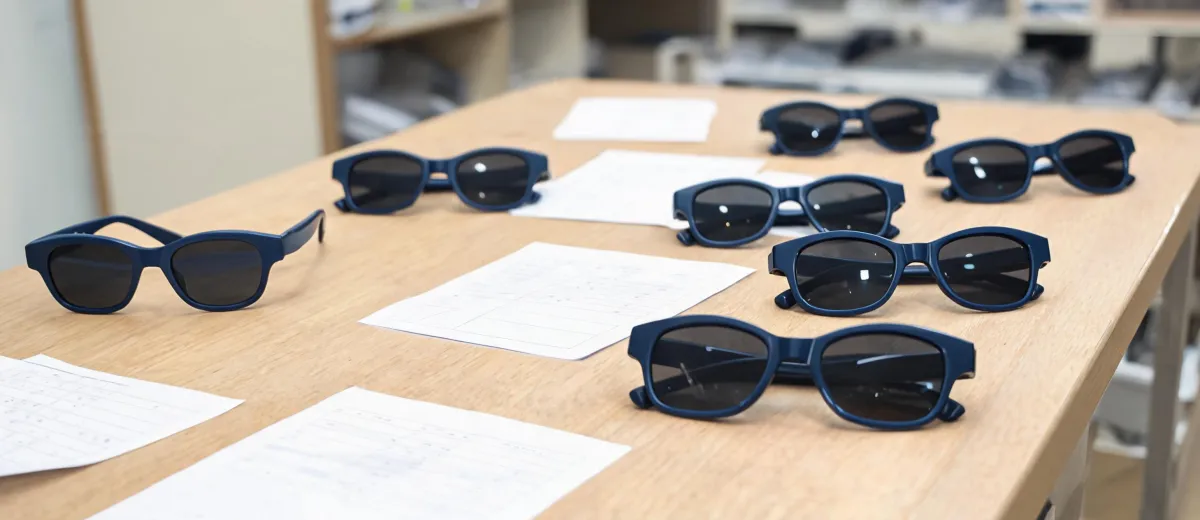
A Thursday Afternoon Call, Six Days Out
The call came in at 4:47 on a Thursday afternoon in June 2024. A brand manager for a women's resortwear label needed 300 pairs of oversized sunglasses for women — polarized, with their logo printed on the temple arms — delivered to a Miami pop-up that opened the following Wednesday. Six days.
Standard turnaround for that order: 25 to 30 days. Custom temple molding alone usually eats about three weeks.
I coordinate rush orders for an eyewear sourcing company, and I've handled 200-plus rush jobs over seven years, including same-day turnarounds for retail chains and event teams. But this one made me sit up. Six days for a custom-logo polarized order, in a size class where a millimetre of frame proportion changes the whole look — that's the kind of request where my job is less about saying yes and more about figuring out what's actually possible.
First Pass: Time, Feasibility, Risk
When I'm triaging a rush order, I check three things in a fixed order: how many hours are actually left, whether the product is physically buildable in that window, and what the worst case looks like. Each one can kill the job before I move on to the next.
Time was the easy part to see. Building the product was harder. The logo was the crunch — molded temple inserts were off the table. Pad-printing was possible only if the frames already existed in stock.
The frames were the second question. Oversized silhouettes and polarized lenses were the client's non-negotiables — that's what their event was built around, and honestly, it's the corner of the market we live in. Polarized oversized sunglasses are what we source most, especially for women's lines where the frame-to-face proportion is the entire selling point. Without the frames, there was no order to chase.
We had three models in stock that fit the brief: two acetate, one injected nylon. Polarized lenses available in each. Good.
Then I hit the third thing, and it had nothing to do with time.
The Part I Had to Say No To
The client's promotional template had a line I couldn't ignore. They planned to print "100% UV400 protection" on the event signage, and their procurement sheet asked us to confirm, on the invoice, that the frames carried an FDA/CE certification the supplier could vouch for in writing.
Here's where the conversation got uncomfortable. We don't write blanket certification guarantees onto invoices. Not because the lenses are weak — the stock polarized lenses we source are tested, and the polycarbonate blanks come with UV400 ratings on the manufacturer spec sheet. But "guaranteed 100% UV protection" is a claim that has to be substantiated per batch, and the FDA regulates sunglasses as medical devices in the US, so the compliance language really matters.
I told her: I can send you the manufacturer's lens test report for the batch, and I can walk you through the standard — ANSI Z80.3 is the US benchmark for non-prescription sunglasses, and it covers UV transmittance, impact resistance, and optical quality. But I can't write a guarantee onto the invoice, and I can't certify a CE mark we don't hold. That's not a paperwork gap. It's a "we don't do this" gap.
She pushed back. I pushed back gently. Then I said the sentence I've learned to say early on rush jobs: "The lens report we can give you is solid. The invoice guarantee we can't. If the guarantee is the priority, we're not the right supplier, and I'd rather tell you that now than in four days."
Silence on the line for about eight seconds. Then: "Send me the report."
The Scramble
We had roughly 90 minutes to lock the order before the client's internal approval window closed for the day. Normally I'd pull three quotes and compare lead times, but there was no time for that. I went with our usual pad-print vendor — 40-plus rush jobs together, zero missed hard deadlines — and committed.
The logo placement turned out tighter than expected. The temple arm on one of the acetate models runs slimmer than the factory spec sheet claims (we've asked for an update twice; still waiting). We had to shift the logo 2 millimetres down the arm. Small thing until it isn't — an off-center logo on a visible temple arm reads as "cheap" faster than almost any other defect I know.
Production wrapped Tuesday morning. 298 of the 300 pairs passed QC. Two lenses had a coating inconsistency we caught under the light box — visible only at a specific angle, but visible. We pulled them, shipped 298, and credited the two.
That's the part I've learned to get right: underreport the good news and overdeliver on the bad. Two short beats a bad review every time.
What I Got Wrong (and What I'd Change)
Looking back, I should have asked about the marketing claims on the very first call, not the third. The certification question is a decision-killer: if it's a hard requirement, the whole job is off the table, and I should know that inside the first five minutes. I learned that the slow way — in 2022, we lost a $14,000 order at the eleventh hour because a client's legal team flagged our invoice language the day before shipping. That's when we started front-loading the compliance conversation on every rush job, no exceptions.
I still kick myself a little on the two rejected lenses. The light box caught them, but I would have rather caught them earlier in the run. If we'd flagged the coating inconsistency on the first 50 pairs, we could have pulled that batch before the whole run finished. Instead, we caught it at the end, and a two-pair credit turned into a two-pair gamble with the schedule.
And honestly? I'm not sure why that vendor's pad-print held up better on our acetate than our internal tester predicted. The adhesion tests were fine. The wear samples were fine. Something about the substrate prep, maybe. If anyone reading this has insight into acetate surface treatment for pad-print adhesion, I'd genuinely like to hear it — because it's the kind of thing I've never fully understood and just work around.
The Lesson I Keep Re-Learning
The client renewed for a fall capsule. Same account manager, larger order — and this time she asked for the lens test report before I had to bring it up.
Here's what I take from that order, and it's the thing I keep coming back to in Oversized Sunglasses Sourcing: the boundary conversation is what closed the deal, not the "yes." When I said "we can't guarantee that certification on the invoice, and here's who does better if that's truly your blocker," her trust in everything else we promised went up, not down.
Specialists who know where their edge is — and say so out loud — get read as more credible than the vendors who promise the moon. I'd rather lose one order because I told the truth than win three because I stretched it and had to walk it back. Because the walk-back always costs more than the lost order.
One last note for anyone planning a similar rush: this all reflects pricing, lead times, and compliance language as of mid-2024. Shipping rates and tariff situations move fast in this category, so verify current terms before you build a timeline around any of it.