Prescription Glasses Sourcing: Verify the Specs Before You Sign a Bulk Order
-
The short answer
-
Why I trust documentation more than a good sample
-
The specs that decide whether custom prescription glasses ship right
-
Where custom clip-on sunglasses for prescription glasses fail
-
Non prescription glasses aren't low-stakes
-
What changed in sourcing—and what didn't
-
Where this advice doesn't apply
The short answer
If you're evaluating a partner for prescription glasses sourcing, the first thing to review isn't the per-unit quote—it's whether the vendor can put documented specifications and a pre-shipment inspection process in front of you. A vendor who can't state the frame material tolerance, lens base curve, and impact-resistance test results in writing is a bigger risk than one charging 15% more who can. That's the conclusion I give every B2B buyer before their first bulk order of custom prescription glasses, and five years of reviewing deliveries hasn't moved it.
Why I trust documentation more than a good sample
My job is to review eyewear before it reaches customers—roughly 200+ SKUs a year across frames, lenses, and clip-on attachments. When I took over this role in 2021, our rejection rate on first deliveries was closer to 18%. I built a verification protocol in 2022: a written spec sheet per SKU, a photo inspection at pre-shipment, and a drop-ball test on every lens batch. The rejection rate fell to roughly 11% within a year.
In Q1 2024 we received a batch of 1,200 metal frames where the hinge-to-temple alignment was visibly off—about 1.8mm against our 0.5mm spec. Normal tolerance for that frame class is ±0.7mm. The vendor said it was “within industry standard” (it wasn't, by their own spec sheet). We rejected the batch and they redid it at their cost. Now every contract spells out hinge-alignment requirements in millimeters.
The point isn't that vendors are dishonest. It's that “standard” means different things to different factories (unfortunately), and a sample only proves one unit at one moment. A documented spec plus a stated inspection step is the only thing that travels with the order. The unit-price gap between a qualified vendor and the cheapest quote was about 15% in quotes we collected in Q4 2024. A single rejected 1,200-unit batch—rework, freight, and a two-week slip—more than wiped out that gap on the next order.
The specs that decide whether custom prescription glasses ship right
Quote sheets rarely include the details that cause rework. For custom prescription glasses, these are the ones I care about:
- Lens base curve — and how it's matched to the frame's wrap.
- Pupillary distance handling — how the vendor captures and transfers PD for custom orders.
- Frame material grade — acetate vs. TR90 vs. titanium, with a tolerance on each.
- Impact resistance — the drop-ball test and who signs off on it.
- Coating spec — thickness and adhesion test, especially for clip-on lenses.
Prescription eyewear sold in the U.S. is regulated as a medical device, and FDA rules (21 CFR 801.410) require lenses to pass drop-ball impact testing. For lens quality, ANSI Z80.1 is the reference most labs work against; for frames, ISO 12870 covers mechanical requirements (verify current editions at ansi.org and iso.org). You do not need to memorize these—you need your vendor to prove they test against them.
Here's the counterintuitive part: the more remote or online your vendor, the more this documentation matters, not less. When you bought from a regional lab you could drive to, a bad batch was a 20-minute conversation. When you're sourcing custom prescription glasses online from a factory you'll never visit, the paperwork is your only leverage.
Where custom clip-on sunglasses for prescription glasses fail
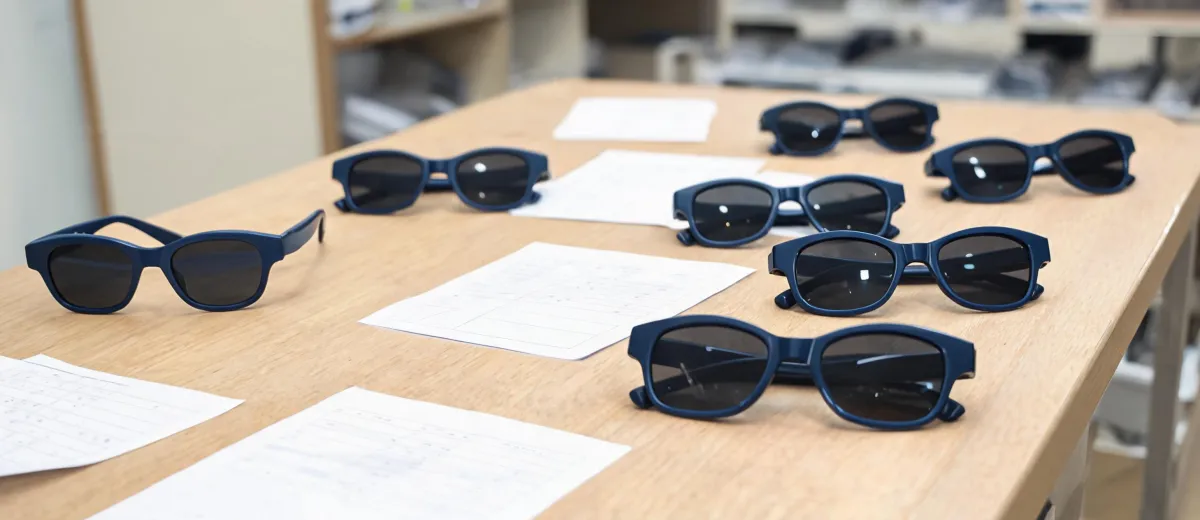
Clip-ons are the category where “close enough” quietly kills repeat orders. The failure modes are specific: the clip doesn't hold tension after a few months (ugh, predictable), or the coating scratches at the three contact points. We ran a blind test with our sales team in 2023—same frame, one with a $1.40 clip-on and one with a $2.60 version. 78% identified the more expensive one as “more professional” without knowing the price difference. On a 5,000-unit run that's $6,000 for measurably better perception.
A lot of buyers ordering custom clip on sunglasses for prescription glasses in bulk treat them as an accessory add-on. I'd treat them as a return-rate driver. If you're specifying custom clip-on sunglasses for prescription glasses for a retail program, keep the clip tension and the coating adhesion in the written spec—not the sales email.
Non prescription glasses aren't low-stakes
There's a persistent assumption that non prescription glasses are low-stakes—no Rx, so what can go wrong. Plenty: impact resistance still applies under the same FDA framework, optical clarity still shows scratches, and a loose hinge on a $12 pair still kills reorder rate. Plan for the same incoming inspection as Rx frames, just with a shorter checklist.
What changed in sourcing—and what didn't
The mechanics of prescription glasses sourcing have shifted a lot since I started. In 2019, custom prescription glasses online was a niche phrase and most buyers defaulted to a regional lab with a three-week turnaround. By 2025 you can spec a custom Rx online, get a digital surfacing quote in a day, and hold a sample in two weeks. The fundamentals—clear specs, documented testing, a real pre-shipment check—didn't change. If anything they got more important, because the vendor is more remote and the temptation to skip verification is higher.
Where this advice doesn't apply
My experience is based on about 200 mid-range orders a year across frames and lenses. If you're working in the luxury segment or the ultra-budget segment, your risk profile is different and my numbers might not translate. I've mostly worked with vendors in established optical manufacturing regions; if you're sourcing from a new region, add a verification step for every new supplier, not just the first.
I don't have hard data on industry-wide defect rates, but based on our five years of orders, my sense is quality issues affect roughly 8–12% of first deliveries—and most of those are spec misunderstandings, not bad craftsmanship.
Two confessions. In my first year I made the classic specification error: I assumed “standard” meant the same thing to every vendor, and it cost me a $600 redo plus a two-week delay. And I still kick myself for not documenting a vendor's verbal promise about lens coating thickness—if I'd put it in writing, we'd have had grounds to dispute the redo charge instead of eating it.
None of this is medical or optical advice. Sourcing decisions don't replace an eye exam, and no vendor can guarantee a fit or a prescription outcome for the end consumer. What a good sourcing partner can do is give you the documentation to prove what you ordered is what you got.