Oversized Sunglasses Sourcing: Which Scenario Fits Your Business?
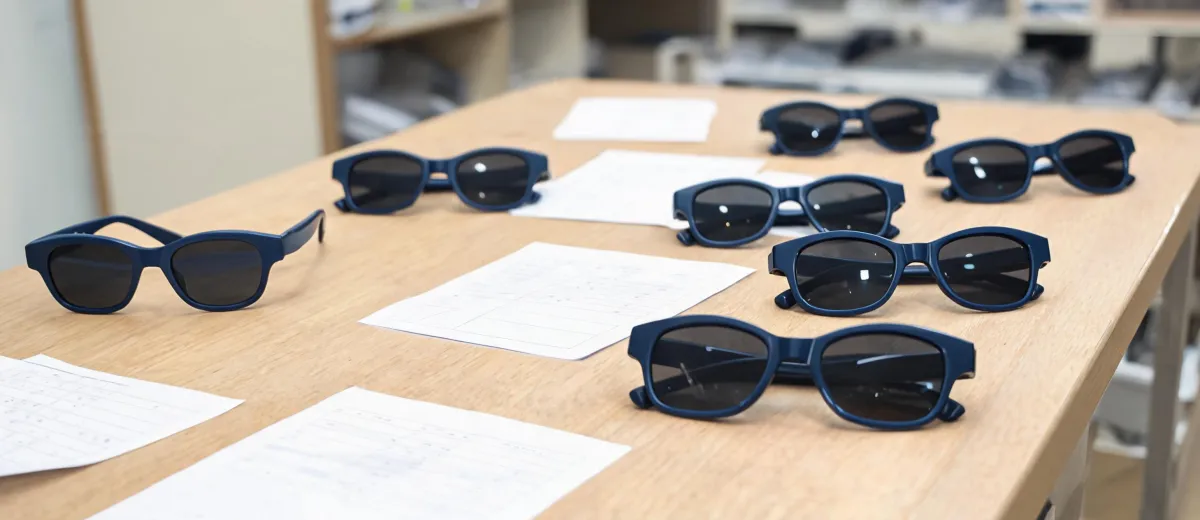
If you're sourcing oversized sunglasses for a B2B channel, there is no single "best" way. The right approach depends on your order volume, customization needs, and how much risk you can absorb. I've managed our eyewear sourcing budget ($220,000 annually) for six years and negotiated with 14+ vendors. I've seen buyers overpay for stock frames and others save 22% by switching to a direct factory—but only after they hit the right volume.
So let's skip the generic advice. Here are three common scenarios, what I'd do in each, and how to figure out where you fit.
Scenario 1: You're Testing the Market (Small Batch, 100–500 Units per Style)
Maybe you run a boutique, a new DTC brand, or a corporate gifting program. You want oversized sunglasses for women or a unisex polarized model, but you're not ready to commit to 5,000 pieces.
My advice: buy stock designs from a trading company. Don't chase full customization yet. Focus on getting samples fast and validating demand.
But watch the hidden costs. Sample fees, shipping, and "lens upgrades" can add 30–40% to your unit cost. I once compared two suppliers for a 300-piece order. Vendor A quoted $6.20 per unit. Vendor B quoted $5.80. I almost went with B until I calculated TCO: B charged $120 for sample shipping, $80 for logo setup, and $150 for polarized film (i.e., the actual feature I needed). Total: $5.80 + $1.17 = $6.97 per unit. Vendor A's $6.20 included everything. That's a 12% difference hidden in fine print.
For small batches, ask for a polarized oversized sunglasses sample first. Test the polarization yourself—hold it up to an LCD screen and rotate. If the screen darkens, it's actually polarized. If not, it's just tinted.
According to FTC advertising guidelines (ftc.gov), claims like "polarized" or "100% UV protection" must be truthful, not misleading, and substantiated with evidence. If your supplier can't provide a test report, you're taking on legal risk.
Consistency. That's the hard part at small volumes. Different production runs can vary in hinge tension and lens tint. (Note to self: always request a pre-production sample before paying a deposit.)
Scenario 2: You're Growing and Need Consistent Quality (1,000–5,000 Units per Style)
Now you have sales data. You know which oversized sunglasses women styles sell. You need repeatable quality, better margins, and maybe custom packaging.
This is where direct factory sourcing starts to make sense. But it's not just about a lower unit price. It's about total cost of ownership (i.e., not just the unit price but all associated costs).
I built a TCO spreadsheet after getting burned twice on hidden fees. For a 2,000-unit order, I compare:
- Base unit price
- Lens upgrade (polarized, UV400)
- Logo printing or engraving
- Custom packaging
- Inspection fees
- Freight and duties
- Payment processing fees
One vendor quoted $4.10 per unit for oversized sunglasses polarized. Another quoted $3.85. But the $3.85 vendor required 100% payment upfront, charged $200 for a pre-shipment inspection, and used a freight forwarder with a 45-day transit. The $4.10 vendor offered 30% deposit, included inspection, and shipped in 25 days. When I added the cost of capital and the risk of a delayed launch, the $4.10 vendor was actually cheaper by $1,400.
Why does this matter? Because a bad batch can cost you more than the discount. In Q2 2024, we switched vendors to save 8% on unit price. The first shipment had 12% of frames with loose hinges. We had to rework them locally. Total cost: $1,200 in rework plus a two-week delay. That "savings" disappeared.
For this scenario, I'd also start testing oversized sunglasses polarized with different lens colors. Women's styles often sell better with gradient lenses, but polarized gradient is harder to source. Ask your factory for a lens color card and request actual samples, not just photos.
Scenario 3: You're Established and Scaling (10,000+ Units, Multiple SKUs, Private Label)
You're not just buying sunglasses. You're building a brand. You need oversized sunglasses sourcing that includes OEM/ODM, compliance, and supply chain resilience.
At this level, the biggest mistake is optimizing for unit price alone. The second biggest mistake is staying with a vendor because switching feels risky.
What I'd do: negotiate a tiered pricing agreement with a factory that has in-house lens production. Lock in resin prices for 6–12 months. Invest in a third-party quality audit. And build a second-source supplier for your top 3 styles.
Hidden costs at this scale: tooling for custom frames can run $2,000–$8,000 per style. Polarized film quality varies—some cheap films delaminate after 6 months. And compliance testing (UV400, FDA registration for sunglasses) can cost $500–$1,500 per SKU if done properly.
From the outside, sourcing oversized sunglasses looks like picking frames from a catalog. The reality is that lens quality, hinge durability, and polarized film consistency vary wildly. I've seen "polarized" lenses that were just tinted. I've seen frames that passed a drop test at the factory but cracked in winter shipping.
The most frustrating part: the same "polarized" claim but different actual performance. You'd think a test report would settle it, but labs vary in their methods. So we now require suppliers to use a specific lab and share the raw data, not just a pass/fail certificate.
This was true 10 years ago when factories only wanted huge orders. Today, many suppliers offer 300-piece MOQs for stock designs. But for full custom oversized sunglasses for women, you're still looking at 1,000–2,000 units per color. That's changed the game for mid-sized brands.
How to Tell Which Scenario You're In
Don't guess. Answer these five questions:
- Order volume per style: Under 500? Scenario 1. 1,000–5,000? Scenario 2. 10,000+? Scenario 3.
- Customization: Stock design? Scenario 1. Logo or packaging? Scenario 2. Custom frame shape and lens? Scenario 3.
- Timeline: Need samples in 2 weeks? Scenario 1. Can wait 45 days? Scenario 2. Can plan 90+ days? Scenario 3.
- Risk tolerance: Can you absorb a 10% defect rate? Scenario 1. Need under 3%? Scenario 2. Need under 1% with audit? Scenario 3.
- Budget: Under $5,000 total? Scenario 1. $5,000–$50,000? Scenario 2. $50,000+? Scenario 3.
If you're between scenarios, default to the lower one for your first order. You can always scale up. It's harder to scale down.
One more thing: don't ignore shipping. According to USPS (usps.com), as of January 2025, a First-Class Mail large envelope (1 oz) costs $1.50. But sunglasses samples usually ship via Priority Mail or courier. For a 2 kg sample package from Asia to the U.S., expect $35–$65 via express. That's a real cost per sample. Budget for it.
At the end of the day, oversized sunglasses sourcing is a total cost equation. The lowest quote rarely wins. The best vendor is the one that fits your scenario—your volume, your quality bar, your cash flow.
So which scenario are you? Be honest. Then build your sourcing plan around that answer, not around a generic checklist.